 ACDSA 2025 — Artificial Intelligence, Computer, Data Sciences & Applications
 Antalya, Turkey ·
  August 7–9 2025
 ACDSA 2025 — Artificial Intelligence, Computer, Data Sciences & Applications Antalya, Turkey · August 7–9 2025
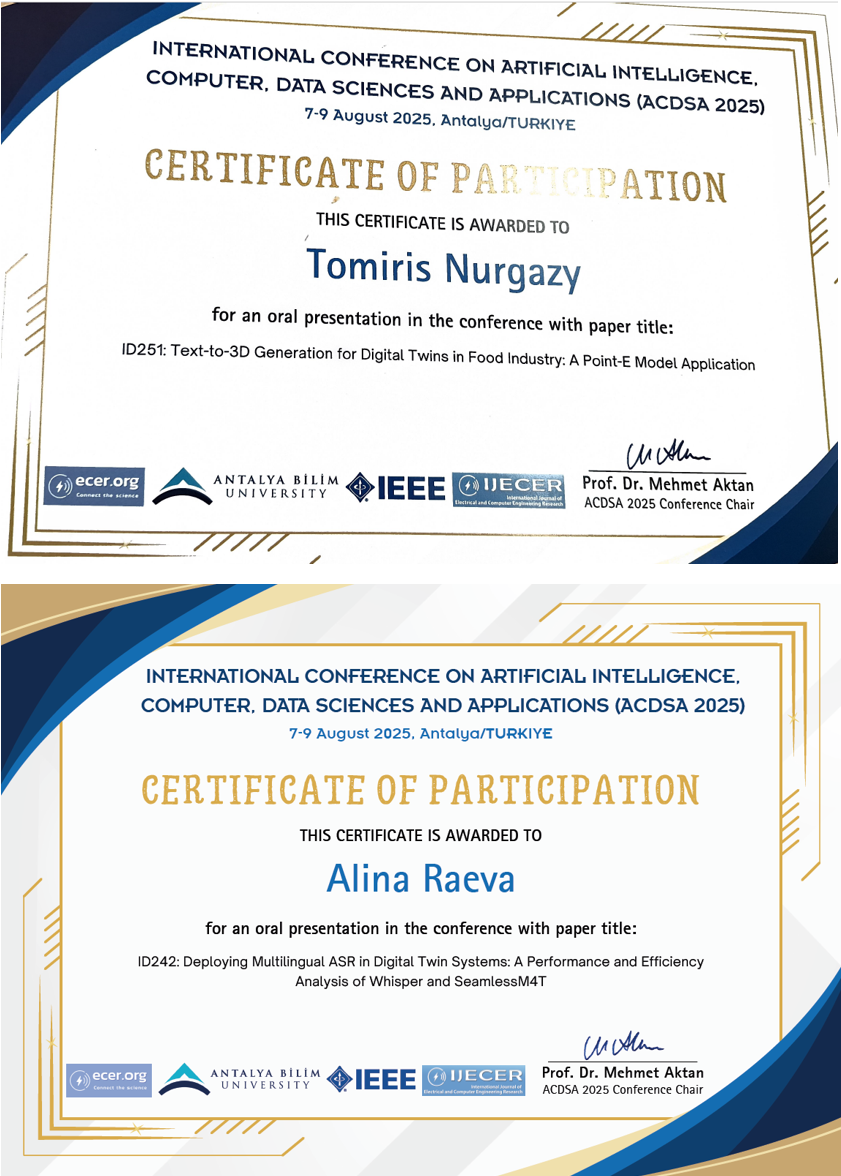
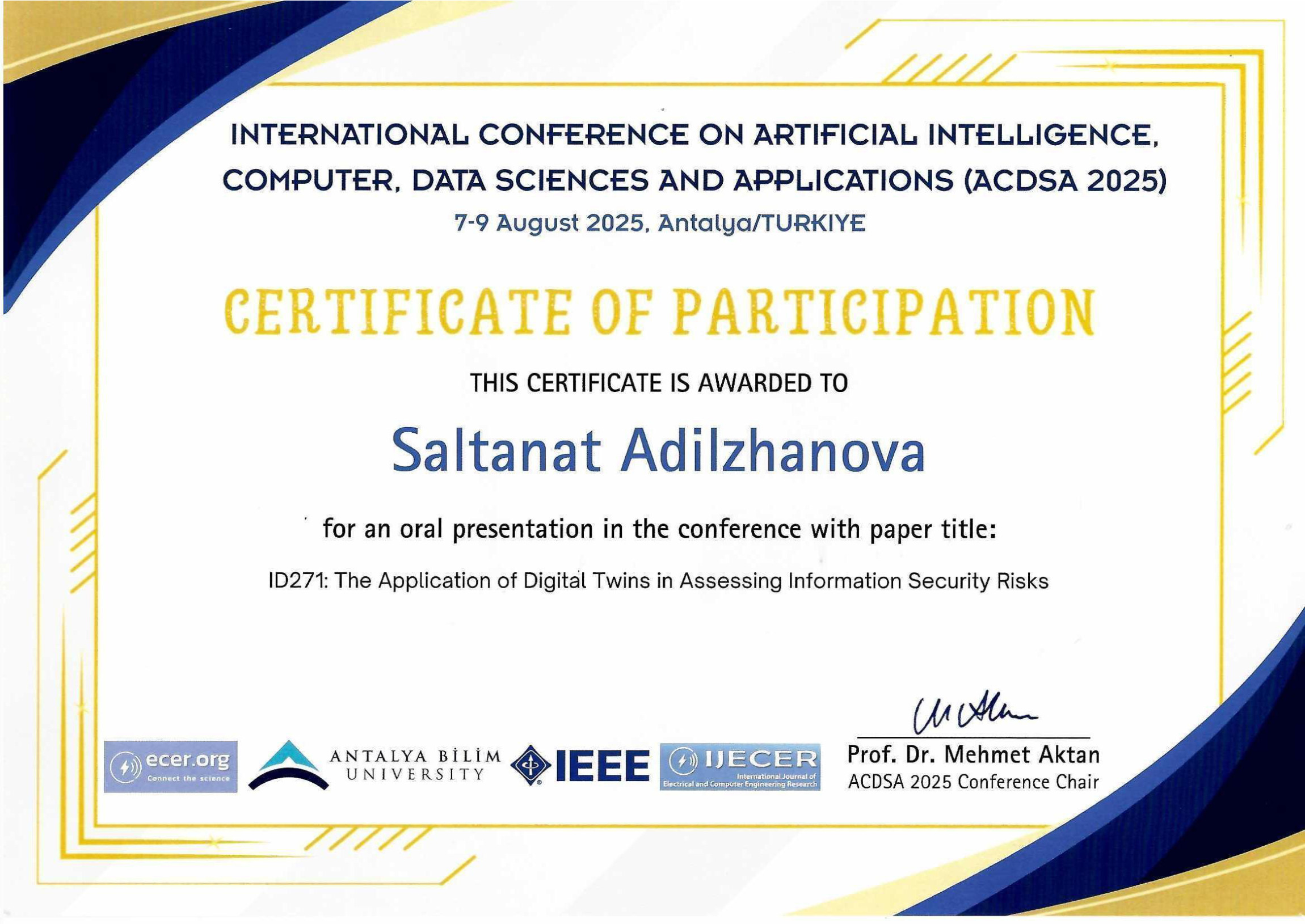
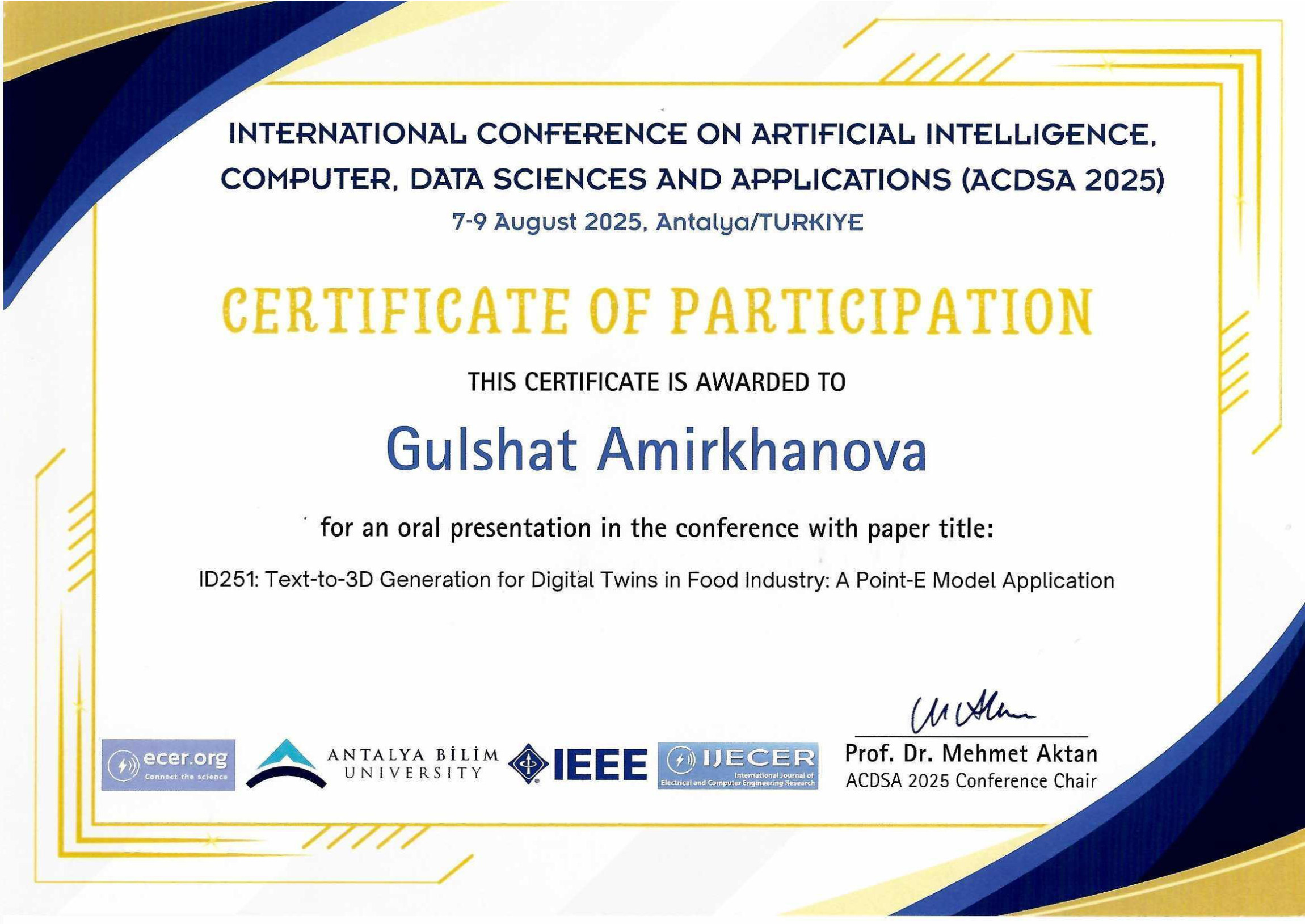
Our team took part at the International Conference on Artificial Intelligence, computer science, data science and applications (ACDSA 2025), having presented four works on the digital twin project for a food processing plant (IRN BR24992975). The conference was held in a hybrid format, bringing together researchers from around the world; the accepted papers have been published in IEEE Xplore.
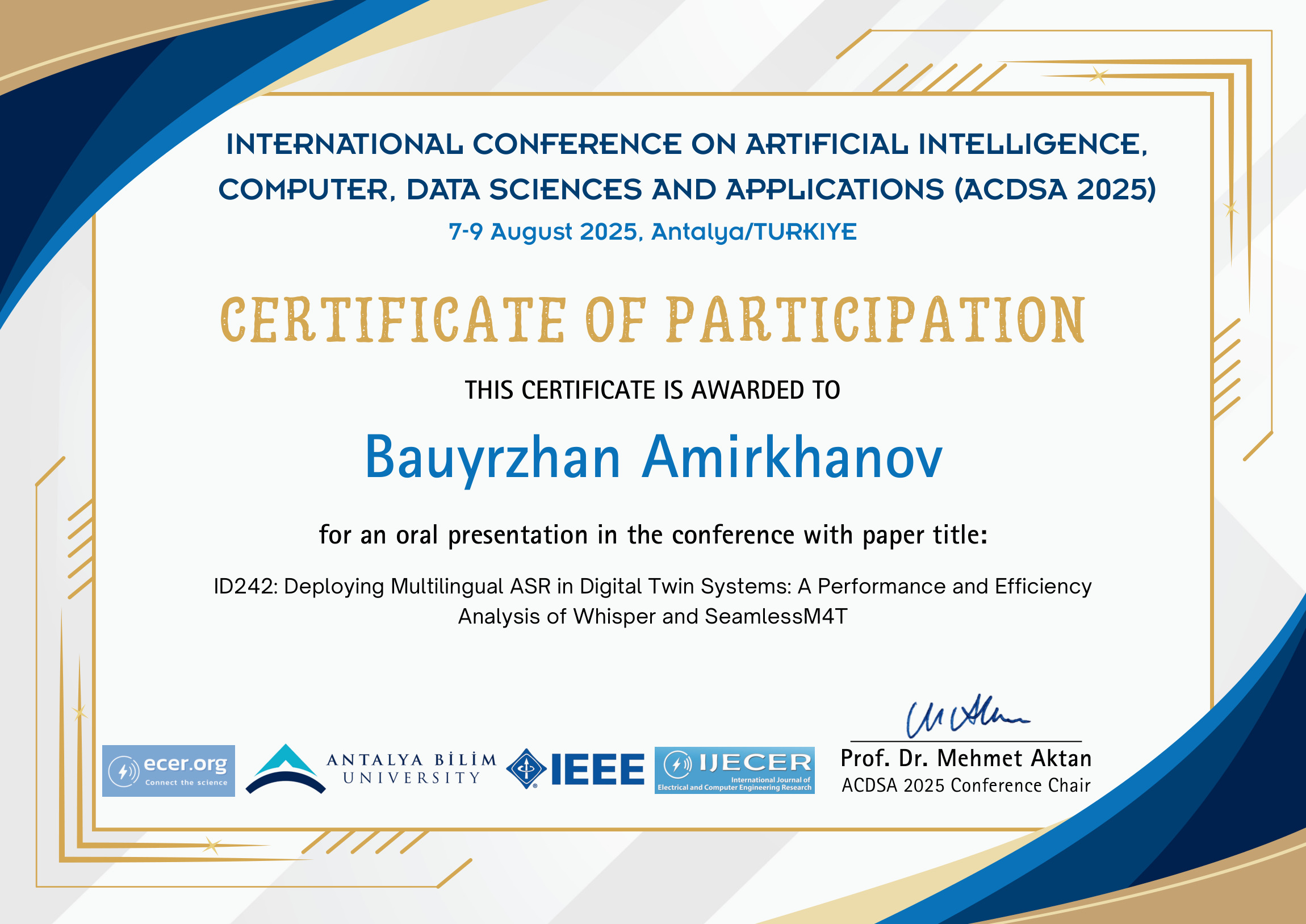
Paper 1. «Deploying Multilingual ASR in Digital Twin Systems: A Performance and Efficiency Analysis of Whisper and SeamlessM4T»
Authors: Bauyrzhan Amirkhanov, Gulnur Tyulepberdinova, Gulshat Amirkhanova, Sholpan Tletay, Alikhan Amirkhanov, Alina Raeva
Summary: A comparison of the Whisper (OpenAI) and SeamlessM4T (Meta) speech recognition systems across three typologically distinct languages—English, Russian, and Kazakh—for digital twin voice interfaces. Evaluation based on accuracy (WER, CER) and GPU memory consumption. Whisper large-v3 achieved the best result for English and Russian, while SeamlessM4T-v2-large did so for Kazakh.
Paper 2. «Digital Twin Integration for Proactive Industrial Decision Support: Enhancing Traccar-Based Monitoring Systems»
Authors: Madiyar Zauranbek, Murat Kunelbayev, Timur Ishmurzin, Miras Tokhtassyn, Nazargozha Abdulkhamit
Summary: Expanding the Digital Egiz platform (based on Traccar) with digital twin capabilities for proactive decision support in production. A decision-making layer with predictive analytics and scenario simulation has been added. This has been tested in three industrial cases: increased efficiency of scheduled maintenance, resource allocation, and anomaly detection accuracy.
Paper 3. «The Application of Digital Twins in Assessing Information Security Risks»
Authors: Saltanat Adilzhanova, Tolkyn Mirkassimova, Gulshat Amirkhanova, Murat Kunelbayev
Summary: The use of digital twins for information security risk assessment. Dynamic threat modeling in real time, cyberattack prediction, and testing of defense mechanisms in a virtual environment using machine learning methods—compared to traditional risk assessment methods.
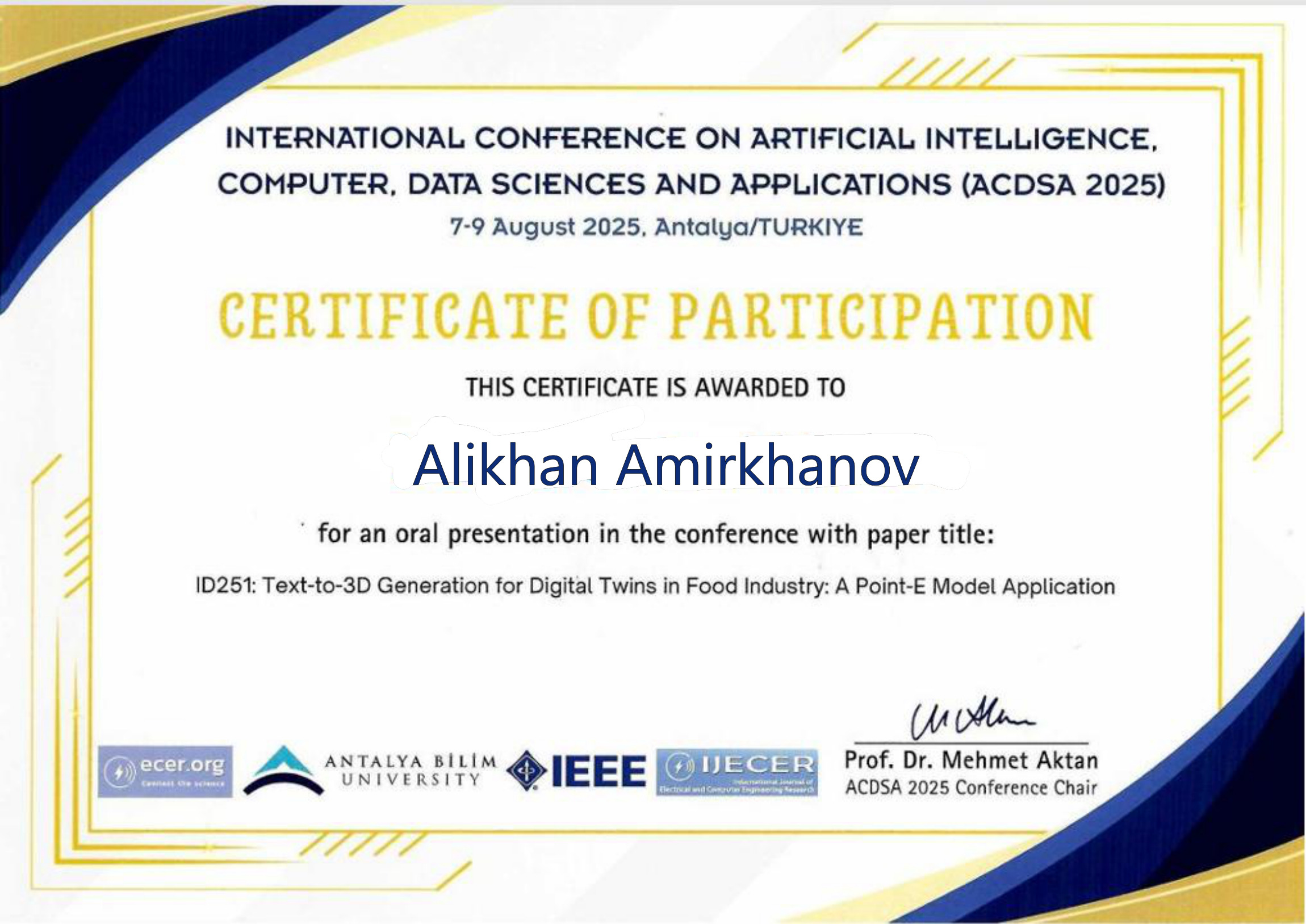
Paper 4. «Text-to-3D Generation for Digital Twins in Food Industry: A Point-E Model Application»
Authors: Tomiris Nurgazy, Gulshat Amirkhanova, Assel Abdildayeva, Nazargozha Abdulkhamit, Azim Aidynuly
Summary: Generation of 3D models of food production equipment and packaging from text descriptions using the Point-E model for integration into a digital twin. Evaluation of tradeoffs between accuracy, detail, and polygonal complexity; a hybrid approach combining AI generation with manual refinement.
The articles are published in the ACDSA 2025 (IEEE) Proceedings, available in IEEE Xplore, and indexed in Scopus and EI.